
Many companies make official websites, and they will carefully prepare a company introduction, put products, and write a few words "professional team, quality assurance".
Of course these can be put. But if every business writes this way, how will customers know who to choose?
Now we also hope that when customers ask AI questions, AI can introduce our company and recommend our products. So, let's take a look at our website first. What content does it provide worth introducing?
For example, if you do enterprise AI training, the website keeps talking about "empowering the enterprise, reducing costs and increasing efficiency", but it does not tell what employees can learn and what work problems can be solved after learning. Customers have to ask again, how much useful information can AI find from it?
Therefore, I would like to talk about how to prepare the content on the website if we want to do a good job of GEO through the official website.
Let's think about it first. Why are customers looking for you?
A business owner wants to give AI training to his employees. What would he ask?
It may be "which positions in our company can use AI", or it may be "employees have participated in training, but they still don't need to do anything when they come back". More specifically, some bosses already know about the agent. They want to let sales do customer follow-up, let people organize the system, and let operations analyze the data, but they don't know where to start.
And what's on our website?
There is only a service name of "enterprise AI training", a few photos of teachers, and a sentence of "tailor-made according to the needs of the enterprise".
How to customize? Which problem can be solved in front? If the customer doesn't know, he has to add WeChat to ask you.
Of course, we want customers to add WeChat, but you must at least tell him what is worth knowing more about first. Otherwise, why doesn't he ask another company?
If I were to plan this website, I would find out the questions that customers often ask, first ask the sales, and then ask the colleagues who are actually responsible for training and delivery. Which questions are answered repeatedly by everyone, which questions will be understood by the customer as soon as we talk about them, and which problems finally affect the transaction. These are all worth sorting out.
Then consider how the page is divided. Should the training for managers and the training for front-line employees be separated? Do companies that are already using AI need the same services as those that are just about to try it? Have we written down the differences?
We can't just organize our website according to what we sell, but also think about what problems customers will come to these things with.
You say you are professional, but what exactly is your major?
When making a website, we always arrange a section for the company to demonstrate its advantages. Professional team, rich experience, perfect service, put a few icons, and it looks good.
But think about it carefully, can these words be used on the websites of their peers?
For example, we say that training can help enterprises implement AI. Then continue to talk about it. Will you understand the work of employees before training? Is the class a unified talk about tools, or practice with actual tasks? Employees come with their own problems, is there anyone to help them solve them? After the course, what can the company get?
Answer these questions clearly, and "landing" has specific meaning.
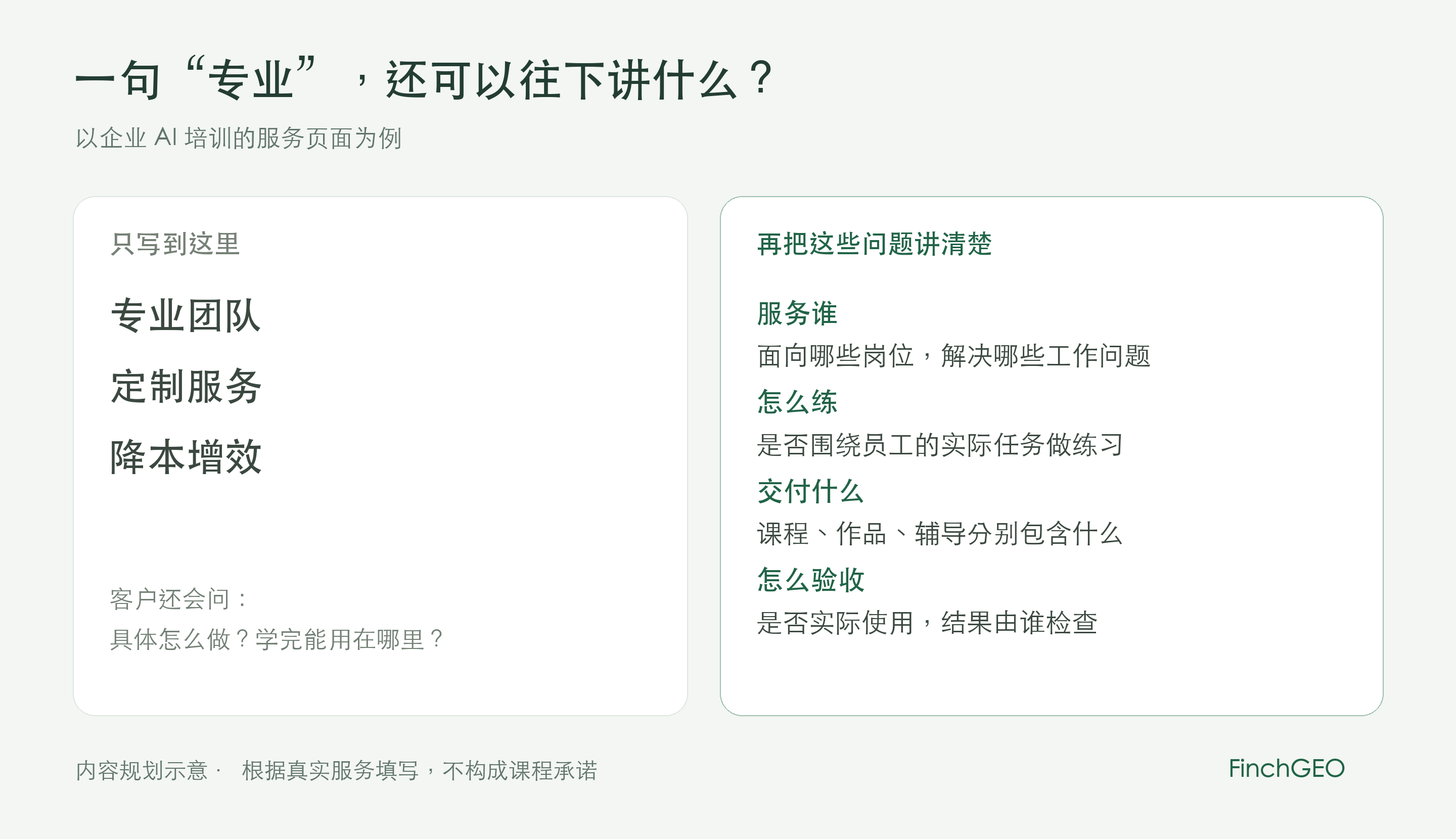
Figure: Using enterprise AI training as an example. On the right is the content direction that can be further explained, not the service commitment that an organization has already provided.
You can write down the services you can actually provide. For example, whether to help the company choose a pilot position, whether to assist employees in completing a usable work, whether to provide after-school tutoring, and how to check the application later. Write what can be done.
Don't write hard without these services. Customers look at the website to find you, and finally find that there is no such thing. Isn't the previous promotion digging a hole for themselves?
Similarly, companies can choose a direction they are good at for a long time, but they cannot think that by repeatedly writing the brand and a few keywords together, they can make AI recognize our expertise. The website must have something to support: how you do it, what experience you have, and which problems are better explained than others. This is worth continuing to accumulate.
"About us" should be written carefully, but there is no need to put together a long essay
Before customers are ready to cooperate, it is normal to understand the background of the enterprise.
What is the name of the company, what is the brand name, where is it, what is the main business, and what information can be verified. If you have qualifications, explain what business the qualifications correspond to, and if there are cases, put cases that can be made public. The brand name is different from the company name, and it doesn't matter. Just explain the relationship between the two.
We write the company introduction carefully to let others know about us. As for the year of establishment, the founder's story, and the corporate vision, whether to expand depends on what these contents can help customers understand. There is no need to deliberately make a long article for GEO.
There are also small places that are easy to overlook. The service area has changed, the contact information has changed, the course has been adjusted, and the introduction on the website is still a few years ago. Customers see two statements from different pages, which one will they believe?
The information released by the enterprise itself should at least be matched first. The office address and registered address can be different, but do not mix them; the services being prepared should not be written as projects that have been delivered.
Customer case, what else can be written besides a group photo?
When it comes to cases, many websites put a photo, plus "so-and-so project successfully completed".
Successful completion is certainly worth celebrating. But other clients probably also want to know: What does this project have to do with me? Do we have the same problems they encountered?
For example, we have discussed before that through the intra-enterprise intelligence competition, employees can share their own methods, share their own experience, and help other colleagues avoid detours.
If such a competition is really organized, what can be written on the official website after it is over?
It can be said why the employee chose that job task, how it was originally done, which part the agent took over, and which part still needs to be checked by people. After the competition, whether anyone continues to use the winning work, and whether other departments learn from it, these are all contents.
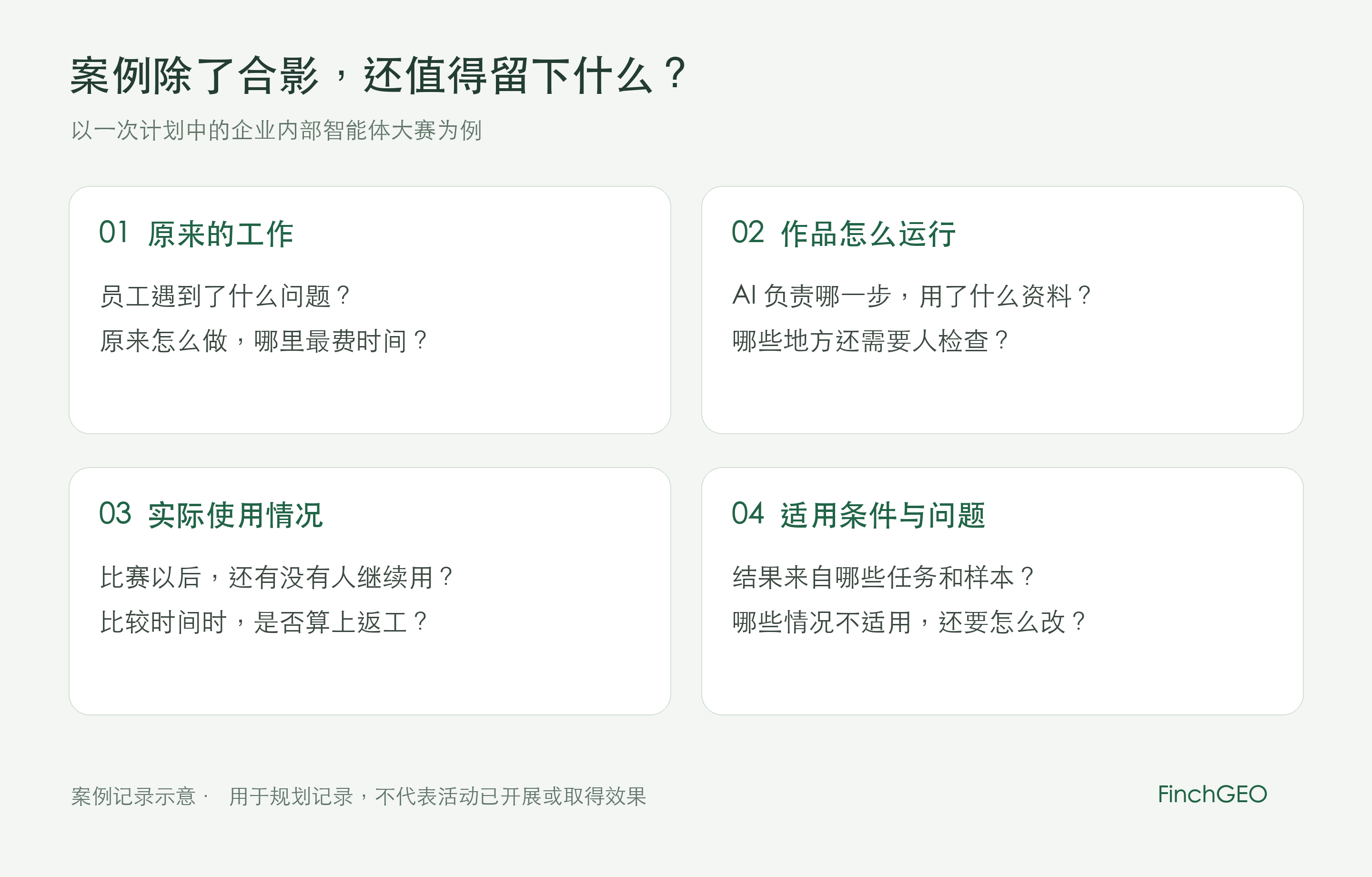
Figure: Illustration of case records. The questions in the figure are used for planning records and do not indicate that activities have been carried out or results have been achieved.
If you want to talk about efficiency, don't just write a percentage. How long was it before, how long is it now, which tasks are compared, and do you count manual inspections and rework? With less time, has the quality of the results changed? These will affect how the reader understands that number.
Some works may be very good when they are demonstrated, but they are actually found when they are used. The information is incomplete, the process is not correct, and they have to continue to change. This can also be written. Other companies may just avoid the same problem after reading it.
There is no result for the time being, so I will write down the process first, and don't worry about giving it a "comprehensive landing" conclusion.
The content from the actual work is what the company can provide. Even if someone else can write an article on the same topic, they don't have the processes and records in your hands.
Then add the questions that customers will ask little by little
The website has service introductions and cases, and you can continue to do so.
For example, after reading a case of an agent, someone might ask, can you do it without programming? Can the company's internal information be used? Who will check the things made by employees? After changing the model, can it still be used?
If you can answer according to your actual experience, organize the answers. Some questions are very simple and can be placed at the bottom of the service page; some questions need to be clear about the premise and operation process, so write a separate tutorial.
You don't have to gather dozens of questions in order to have a FAQ column, and you don't have to go back to "Welcome to Contact Us" for every answer. Others do have questions, and they will only look at the answers. If you repeatedly ask him to contact you, but never say the specific content, will he think that you just want to get the contact information?
The tutorial and the case should also be able to find each other. After reading the method, if you want to understand the practical application, you can enter the case; after reading the case, if you don't understand one of the steps, you can also find the corresponding instructions. When the reader is willing to continue to understand, the website should give him a convenient place to go.
Google's content guidelines also mention original information, actual experience, and clear sources. These can help us check the quality of content, but it cannot be inferred from this. As long as tutorials and FAQs are added, AI will definitely cite them.Refer to Google Content Guidelines
The website has been changed, and we have to see what the AI has to say
We've done so much, and of course we still hope for results.
Then take the questions that customers may ask, go to the actual search, and see how the AI answers. Does it know what we do? Did you say the business wrong? Is there a link to our website in the answer? Can the page you click on support what it said?
Don't just search for your own brand name. What customers will ask when they don't know us is also worth testing.
However, if you ask us today, but not tomorrow, it doesn't necessarily mean that there is a problem with the website. In the test, you need to record the platform, problem, time, and whether it is connected to the Internet, and check it every once in a while. After changing a page, the effect of the screenshot will be improved, which is difficult to judge.
Here are a few things to distinguish: the webpage is included, the answer mentions the brand, the answer quotes the official website, and the customer finally consults, which is a different result. One of these things cannot replace the others.
As for the technical settings of the website, check for practical problems. For example, if the text can be seen in the browser, is the content obtained when crawling complete? Have important pages been incorrectly set to not allow indexing? These can be checked by the person in charge of the website.
Taking Google's AI overview and AI model as an example, the official said that the existing SEO foundation still applies, and no additional dedicated AI files are required; it meets the requirements, and there is no guarantee that it will be included or displayed. Other platforms should be looked at separately, and the description of one platform cannot be regarded as the rule for all AI searches.Refer to the Google AI feature description
So, if you ask me, what does a website that meets AI search look like?
I will first see if this website has seriously answered the customer's question. Can you find the business that the customer wants to know about? The company says it has an advantage, can you tell me something specific? Has the case really been done, and is there any basis for the result?
Before these things were done, I was busy studying how to get AI to recommend myself. I felt a bit anxious.
First take out what is worth knowing about the company, explain it clearly, and stay. In the future, there will be new practices, and then add. The content accumulated on the website will become more and more useful.








 Add customer service qq.

netizens commented